Showing posts with label rock. Show all posts

Sunday, December 30, 2012

Steely Dan / The Royal Scam (1976)

Royal Scam is like the middle child in the Steely Dan discography, a precocious adolescent record that is somewhat awkward in its nascence while offering tantalizing hints at the brilliance and sophistication that became the band's hallmarks. I don't listen to it nearly as often as its immediate predecessor Katy Lied or masterful successor Aja, but each time I do, I remember what I'm missing. Those might be two of my favorite albums, but Scam is an underappreciated gem hiding in the shadows of its bigger brothers. I think it unfairly suffers for sounding, perhaps, too similar to Katy Lied while not quite achieving the same level creamy sophistication that was captured on Aja. Indeed, many of the songs would fit in nicely with the set on Katy Lied, and if you were so inclined, a seamless resequencing of the two records isn't a far fetched idea. But regardless of Scam's lack of further groundbreaking in terms of stylistic appeal, if you like Steely Dan, then you should find plenty to sink your teeth into. Scam has all the characteristics I attribute to Becker and Fagen's work.

As per usual, no two songs sound alike, and each one features a core group enhanced by a veteran session man. These contributions provide a variety of aural textures that buoy the program. Whether they are anchoring the rhythm section or setting the front line on fire, you can always expect fireworks from the sidemen on a Steely Dan LP. On almost every track, I really enjoy the Chuck Rainey's solid and soulful bass playing, for instance, and prominent work by guitarist Larry Carlton imparts a dazzling and sometimes grainy feel that was missing among the fold of Katy Lied. (The scholars among us will note that Carlton did the guitar bit on Katy Lied's "Daddy Don't Live in That New York City No More.") You'll also note the work of Steely stalwarts Denny Dias, playing the first solo in "Green Earrings" and Elliott Randall, who does the second. Becker steps out from behind the glass and gives the solo on "The Fez." And while he only gets a single solo spot, Paul Griffin plays piano on "Sign In Stranger," an ascerbic poke at musician union cronies. It's easily is my favorite track and possibly the best solo on the record.

Of course, it wouldn't be Steely Dan if the lyrics didn't tell great stories (part fact, part fiction?) in entertaining and cryptic language colored by great one-liners. Right out of the gate, Fagen spins sly yarns about counterculture kingpins, the music business, coming of age, and the plights of stupid young lovers, with more than a dash of wry irony and humor. Musical styles bridge the territory between jazz, soul, blues, pop, disco, and full-out rock and roll. I suppose that is what the word "fusion" is for, but because it has acquired other connotations that do not apply to Steely Dan, I want to steer away from it. If you're having trouble decoding some of the lyrics or want to fully appreciate the juicy imagery employed by Fagen, then stop by and have a look at the Steely Dan Dictionary.  It's a user supported thing, so shoot them an email if you've got something to share. If that doesn't do it for you, then visit the Official Steely Dan Homepage FAQ -- which actually references the aforementioned SD Dictionary. I think you'll find the website is as entertaining as some of their liner notes. I've been listening to this record for a few hours now, and started my latest affair with it a few days ago. It's a rare thing when a record wears in to the equivocal point of a runner's high, providing more enjoyment on repeat listening, rather than less. There aren't many acts who can pull that off. As far as music goes, I love these guys. And I hope they don't ever stop. 

Monday, October 29, 2012

Wire / A Bell is a Cup until it is Struck (1988)

Wire was always hard to pin down with only a few words. Before punk, post-punk, industrial, new wave, no wave, and cold wave were household descriptors, Wire's music seemed to encompass qualities of all these styles seemingly at once. The band's sound was always a few steps ahead of whatever was popular (or unpopular), and Bell is no exception. It retains the obtuse lyrics, Dadaist sensibility, and lush aural textures that seasoned listeners appreciate. The 1970s punk aesthetic is replaced, at least on the surface, by more relaxed vocals and more sophisticated sonics, so the product is more accessible than ever. If you're looking for attitude, it's alive and kicking in the biting lyrics and musical content, too. There is even a hit single, "Kidney Bingos," a pop oddment destined for obscurity if not for an earworm chorus. Side two gets down to business and reminds you which group you're listening to, and completes the recipe for a good Wire record replete with aggressive noise, ghastly synths, and buzzing guitars aplenty. It's a diverse collection of songs that will appeal slyly to listeners more accustomed to conventional rock and electronic music, while still delivering the choice alternative goods to the faithful.

Thursday, September 13, 2012

The Grateful Dead / Workingman's Dead (1970)

The summer of 1970 was the summer of the Grateful Dead. Talk about a busy group -- a mammoth American tour with New Riders of the Purple Sage, nightly concerts lasting until dawn, two studio albums, writing new material, a change of format.... you can tell I'm impressed. Although released several months before American Beauty, the slab Workingman’s Dead is definitely in the same vein, stylistically, but the records aren’t interchangeable. Workingman’s Dead is darker than the successor, in both content and production. The albums also had different producers. But together, they are the fraternal twins of the Dead’s americana period. As with American Beauty, the two characteristics that stand out most are the lyrical contributions of Robert Hunter and the band’s rich vocal harmonies, the latter influenced by a friendship with Crosby, Stills, and Nash. Both are introduced on the side one opener, “Uncle John’s Band,” which is an archetypal acoustic singalong affair, marked by a lighter touch from all involved and some uncanny vocal harmonies. Garcia’s work throughout the record is considerably more diverse than it was later that year. He picks 5-string banjo for the careening “Cumberland Blues” and his gritty licks on the Stratocaster take center stage for “Easy Wind” and “New Speedway Boogie.” The country ballad “Dire Wolf” is propelled by Garcia's masterful work on the pedal steel, and along with Bob Weir, his acoustic guitar is everywhere. Pigpen does the tough album’s toughest number, “Easy Wind,” before everything is drawn to a close with the unforgettable “Casey Jones.” Damn! What a good record. As with other CD re-releases in the Dead's back catalog, it comes with bonus tracks that make entertaining filler, but are what I consider to be nonessential material that should have been placed on a second disc. Am I the only person who wants to preserve original continuity? When I hear that telltale sniff at the beginning of Casey, I want the record to end. It's the whole point, after all. But I don't let that bother me, and I listen anyway.

Saturday, May 26, 2012

Pillars #2: Psychedelic Rock - The Teardrop Explodes / Wilder (1981)

It’s a fitting title: Wilder is a more diverse, experimental, and, well, wilder effort than the band’s debut. The songwriting goes down a darker path, too, both lyrically and sonically. Dave Balfe’s keyboards and synth loops are more prominent than on Kilimanjaro, sometimes the only accompaniment to a troubled, mumbling Cope. Haunting aural textures and shifting dynamics create a lost, paranoid, and decidedly psychedelic atmosphere that is supported by the album's fragmented track sequence. Cracking singles like side-two opener “Passionate Friend” showcase punchy arrangements and act as buoys between bouts of strangeness, while tracks like “Tiny Children” and “…And The Fighting Takes Over” move into quieter, more nebulous spaces of druggy, introspective beauty and confusion. I love the wry lyrics and paranoid mood of "Like Leila Khaled Said" and Police-ish multilayer drumming of "Seven Views of Jerusalem." The latest CD release has bonus tracks that may interest serious fans, but they are nonessential and ultimately ruin the record’s continuity. Original sequencing stops at “The Great Dominion,” a sweeping closer to the brilliant’s group’s short career. The song has an epic scope somewhere between a great accomplishment and a hint of what could have been. Either way, it's Cope's greatest moment on wax and a remarkable accomplishment for a pop record. 

Frank Zappa - Waka/Jawaka (1972)


Waka/Jawaka is the conceptual follow-up to Hot Rats, the precocious middle child in the Hot Rats trilogy (Hot Rats, Waka/Jawaka and The Grand Wazoo). Although Waka is very enjoyable by itself, it’s a style in transition, a more complex offering that contains beginnings of the big band sound later featured on the Grand Wazoo while retaining only impressions of the hard rock grit from Hot Rats. The band, the structure of the compositions, and the instrumentation are all in development. Overall, it is a much better approximation of jazz-rock fusion than the heavy blues rock comprising most of the Hot Rats set. “Your Mouth” features a dose of the sarcasm you’d expect from Zappa, with a slinky melody and nice slide work by Tony Duran. But it’s the bookends that really light things up. Opener “Big Swifty” and closer “Waka/Jawaka” are two long jazz suites, a form that became Zappa’s favorite vehicle. These are tightly arranged but have the loose feel of a rock band in full flight. There are some awesome solos, too: Don Preston’s escapade on the Mini-Moog during “Waka/Jawaka” is as notorious as it is entertaining: upon hearing it, inventor Bob Moog supposedly remarked that such music was impossible on his instrument. Zappa’s electric guitar colors the entire album, sounding more accomplished here than on Hot Rats, always reminding listeners of the ‘rock’ half of the ‘jazz-rock’ recipe. It’s an enjoyable spin by itself, but is best heard in context with the other albums in the trilogy. I recommend taking an afternoon and listening to Hot Rats, Waka/Jawaka, and The Grand Wazoo, in that order. When you’re finished, listen to all three again. Afterward, you’ll understand what Zappa was cooking up. It isn’t pop music. It isn’t dance music or background music or music for parties, like other music from 1972. It’s music that rewards active listening because behind the fuzz bass and swirling Mini-Moog, there are ideas. The Ryko CD release was doctored up a little bit and sounds different than the original LP. In spite digital reverb applied to the final production, it still sounds nice.

Sunday, April 22, 2012

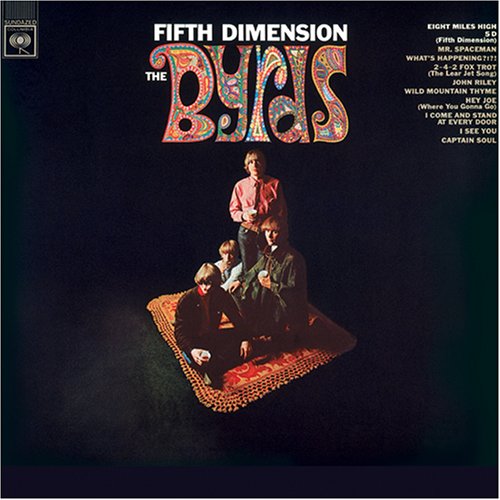
Pillars #1: Psychedelic Rock - The Byrds / Fifth Dimension (1966)

Question: I see this review is a Pillars entry. Why is this album so important to its genre?

Answer: Because it was the first commercially successful collection of psychedelic rock on a major label.

Yeah, there were psychedelic rumblings in other parts of the country that were notable in their own right. And yeah, I know, commercial success shouldn't be an indicator of a record's value. But sometimes marketability really matters, and that's the case here. The Byrds had a high profile as a successful folk-pop group. They were a friendly, smiling group with pleasant music that was popular on AM radio stations. They were on TV. They sold a lot of records. You can see where I'm going with this... friendly, popular, pleasant... and then BOOM. Like sneaking a party in through the back door, they dared to follow through on a new kind of music they believed in. They explored the fringes for the rest of us, and their major label distribution tapped an unprecedented audience. But that's enough about the social import, let's talk about the music.

Fifth Dimension has been called a transitional album because of the band's new found artistic control and spirit of experimentation, both accomplished within a pop song format. Fans of psychedelic pop music by Kevin Ayres, Pink Floyd, the Beau Brummels, the Pretty Things or the Beatles should take to this material very easily. The lineup is the same as before, minus Gene Clark. But the result is such a departure from the previous two albums that it feels like a whole new band. Indeed, with Crosby and McGuinn taking the helm, it almost was. Most notably, and thankfully, there isn't a single Bob Dylan cover. I like the Byrds' Dylan covers just fine, they're excellent, but when I listen to those first two records, for every Dylan cover, I can't stop thinking of at least one original Byrds tune that doesn't exist.

The side 1 opener "5D (Fifth Dimension)" sets the bar for the rest of the set. Its lyrics join the hands of faith and reason, explaining our universe through the Einsteinian lens, with grateful acceptance of its divine creator. As McGuinn related in So You Want to be a Rock and Roll Star, "5D was an ethereal trip into metaphysics, into an almost Moslem submission to an Allah, an almighty spirit, free-floating, the fifth dimension being the 'mesh' which Einstein theorized about. He proved theoretically - but I choose to believe it." The band's fans interpreted the lyrics as drug related, which caused an outcry and several bans from radio play. No publicity is bad publicity, right? The song's detractors only fueled its ascent, and it reached #44 on Billboard's Hot 100 -- a testament to the endurance of the new, more thoughtful variety of rock and roll that was being born.

"Mr. Spaceman," somewhat of a throwaway single upon the first listen, is one of my favorite Byrds tracks. It has been retained by McGuinn and is still part of his live repertoire. He claims Crosby didn't think the song should make the final cut because it wouldn't make any money. He thought his rocker "Hey Joe" was a better bet for a single. Thankfully, Crosby lost that argument. Its humorous lyrics describe nocturnal visitations by extraterrestrial life forms, and after insisting he is a peaceful being, the narrator pleads with them to take him off of the Earth. This is a pretty serious song. We Earthlings like to think no one can see us, that we're out here on the edge of the Milky Way all by our lonesome selves. But what if that wasn't true? Considering the spiritual sentiments expressed in "5D," the lyrics of "Hey Mr. Spaceman" take on a new tone. Consider your neighbors might live next door to your planet, too, and treat everyone as a member of the same family. You were created, you are never alone, and truth is but one point which is multiplied by fools..

"Eight Miles High" is another charting single with some killer guitar work by McGuinn. His intro lick and freakout solo are an attempt to play modally as John Coltrane was doing at that time. The guitar has its characteristic overdriven and clear ringing tone. McGuinn says it was a feat of production, running the guitar signal through a compressor before entering it directly into the board. Otherwise, as anyone who picks up a Ric will tell you, the guitar's tone is a resounding thud with little of the sustain integral to the Byrds' appeal. More of such droning, atonal psychedelic rock can be found in "What's Happening?!?!" Crosby penned the tune, which asks the immortal question of why anything exists. The sentiment expressed in the lyrics are interesting to me as an illustration of the differences between McGuinn and Crosby, the former having already answered the question posed by the latter.

There are other tracks which fill out the album and make it really nice to listen to. "I Come and Stand at Every Door" echoes Pete Seeger's performance as a response to the war in Vietnam, and a plea for peace. The Scottish folk ballad "Wild Mountain Thyme" is transmuted from the inertia of the social climate, or, rather, the symbolic discussion of death in its lyrics is for once accurately and with purpose put forth for a listener. The production of the track is lushly orchestrated with strings and plenty of fingerpicking from McGuinn. The album draws to a close with "2-4-2 Fox Trot," which steadfastly upholds the tradition of offbeat Byrds closers. It incorporates Crosby and McGuinn's mutual interest in airplanes and uses some cool sound effects of jet engines and radio transmissions over the refrain. It's an odd number and the lyrics beg the listener to ride the Lear jet. It's almost like asking listeners to get high... in the sky, that is. It's been my least favorite track until recently when I've come to really dig the sound effects as a sort of musical noise. So many incongruous sounds are merging at once, it's an adventurous technique to use in a pop song.

A final note: if you read my review and you also read Richie Unterberger's review on the dreaded All Music website, please ignore Mr. Unterberger's comments about how uneven the record is. So much criticism is a fine bit of hindsight but it says nothing for the other merits of the album that outweigh any problems of selection or sequencing. Fifth Dimension is still fun to listen to and it stands as a benchmark recording that was made in a hurry under special circumstances. It's very important as the transition between ephemeral pop simplicity and the deeper waters of a new musical style that would grow to have long lasting and cross-generational appeal. Please enjoy.

Thursday, January 26, 2012

The Pogues / If I Should Fall from Grace with God (1988)

Aaah, the Pogues. They took Irish folk music, stripped it down to the nerve, and then strapped what was left to the back of a freewheeling, green-eyed punk machine. The result was a radioactive new music that blasted through speaker cones like Godzilla in a donnybrook. Out of all the Pogues' original albums and EPs, it's damned hard for me to choose a favorite. I even like Waiting for Herb, just so you know who you're talking to. But it's this Pogues slab that gets the most play around my house, and quite possibly because it's the only one that survived.

If I Should Fall from Grace with God was produced by Steve Lillywhite in 1988. His approach retained the attitude and drive of the band, while showcasing their skills as instrumentalists and songwriters. MacGowan's lyrics, his poetry, are a joy to read even without music, and here they finally see the light of day at the front of the mix. There's plenty of barking and howling, too, but between the primal punctuation marks, a listener can actually make out what he's singing. If you've ever burned time trying to discern Michael Stipe's autistic mumble in an REM song only to come up with more riddles than you started with, you'll appreciate the relative no-brainer presented by Grace. MacGowan has a gift for turning a phrase within the kinetic context of a rock and roll song that few other songwriters can manage. The product is something that works both melodically and as a narrative. Sketches of story fly by, vague impressions are tossed out, and any guesswork is left to the imagination, guided by the mood of the music behind the words.

Lillywhite's slick production is evident from the outset (these tracks sound organized!), but you know you're getting a Pogues record when you hear the aftermath of the title track's cascading accordion intro, MacGowan's cracked snarl, and classic shoutalong chorus describing a victorious day at the races. Instead of a bridge, many songs employ a thundering interlude where the band breaks into another tune. "Turkish Song of the Damned" has a Middle Eastern feel but is backed by the banshee wails of fellow band members, and sudden modulations in key follow each determined section. There's even holiday appeal in the twisted Christmas carol "A Fairytale of New York" where MacGowan trades barbs with Kirsty MacColl in call-and-response format. The cynical quips and rich imagery are pure Poguetry.

There's almost too much good music to get into here. If you buy the CD, you'll get two extra tracks that were omitted from the LP and cassette releases due to time limitations. Looking at prices around the net, I'd say it's a stonking bargain.

If you've read enough of this review and want to buy the record, try hitting up a seller at Discogs.com.
If you'd like to learn about the Pogues from a more credible source, then visit the Pogues official website.