Showing posts with label review. Show all posts

Saturday, January 19, 2013

365 Dry Martinis, my new blog.

 
I've done a little bit of jazz reviewing here on Dusty Slabs, but I've opened a new, jazz-only review blog called 365 Dry Martinis. Stop by and read short reviews of a different jazz album each day. They're each under 10 sentences, a form that I'm discovering is much harder to master than it sounds. If you're interested then please follow the link below, or you can find it in the sidebar at right. Have a nice day...

Sunday, December 30, 2012

Steely Dan / The Royal Scam (1976)

Royal Scam is like the middle child in the Steely Dan discography, a precocious adolescent record that is somewhat awkward in its nascence while offering tantalizing hints at the brilliance and sophistication that became the band's hallmarks. I don't listen to it nearly as often as its immediate predecessor Katy Lied or masterful successor Aja, but each time I do, I remember what I'm missing. Those might be two of my favorite albums, but Scam is an underappreciated gem hiding in the shadows of its bigger brothers. I think it unfairly suffers for sounding, perhaps, too similar to Katy Lied while not quite achieving the same level creamy sophistication that was captured on Aja. Indeed, many of the songs would fit in nicely with the set on Katy Lied, and if you were so inclined, a seamless resequencing of the two records isn't a far fetched idea. But regardless of Scam's lack of further groundbreaking in terms of stylistic appeal, if you like Steely Dan, then you should find plenty to sink your teeth into. Scam has all the characteristics I attribute to Becker and Fagen's work.

As per usual, no two songs sound alike, and each one features a core group enhanced by a veteran session man. These contributions provide a variety of aural textures that buoy the program. Whether they are anchoring the rhythm section or setting the front line on fire, you can always expect fireworks from the sidemen on a Steely Dan LP. On almost every track, I really enjoy the Chuck Rainey's solid and soulful bass playing, for instance, and prominent work by guitarist Larry Carlton imparts a dazzling and sometimes grainy feel that was missing among the fold of Katy Lied. (The scholars among us will note that Carlton did the guitar bit on Katy Lied's "Daddy Don't Live in That New York City No More.") You'll also note the work of Steely stalwarts Denny Dias, playing the first solo in "Green Earrings" and Elliott Randall, who does the second. Becker steps out from behind the glass and gives the solo on "The Fez." And while he only gets a single solo spot, Paul Griffin plays piano on "Sign In Stranger," an ascerbic poke at musician union cronies. It's easily is my favorite track and possibly the best solo on the record.

Of course, it wouldn't be Steely Dan if the lyrics didn't tell great stories (part fact, part fiction?) in entertaining and cryptic language colored by great one-liners. Right out of the gate, Fagen spins sly yarns about counterculture kingpins, the music business, coming of age, and the plights of stupid young lovers, with more than a dash of wry irony and humor. Musical styles bridge the territory between jazz, soul, blues, pop, disco, and full-out rock and roll. I suppose that is what the word "fusion" is for, but because it has acquired other connotations that do not apply to Steely Dan, I want to steer away from it. If you're having trouble decoding some of the lyrics or want to fully appreciate the juicy imagery employed by Fagen, then stop by and have a look at the Steely Dan Dictionary.  It's a user supported thing, so shoot them an email if you've got something to share. If that doesn't do it for you, then visit the Official Steely Dan Homepage FAQ -- which actually references the aforementioned SD Dictionary. I think you'll find the website is as entertaining as some of their liner notes. I've been listening to this record for a few hours now, and started my latest affair with it a few days ago. It's a rare thing when a record wears in to the equivocal point of a runner's high, providing more enjoyment on repeat listening, rather than less. There aren't many acts who can pull that off. As far as music goes, I love these guys. And I hope they don't ever stop. 

Monday, October 29, 2012

Wire / A Bell is a Cup until it is Struck (1988)

Wire was always hard to pin down with only a few words. Before punk, post-punk, industrial, new wave, no wave, and cold wave were household descriptors, Wire's music seemed to encompass qualities of all these styles seemingly at once. The band's sound was always a few steps ahead of whatever was popular (or unpopular), and Bell is no exception. It retains the obtuse lyrics, Dadaist sensibility, and lush aural textures that seasoned listeners appreciate. The 1970s punk aesthetic is replaced, at least on the surface, by more relaxed vocals and more sophisticated sonics, so the product is more accessible than ever. If you're looking for attitude, it's alive and kicking in the biting lyrics and musical content, too. There is even a hit single, "Kidney Bingos," a pop oddment destined for obscurity if not for an earworm chorus. Side two gets down to business and reminds you which group you're listening to, and completes the recipe for a good Wire record replete with aggressive noise, ghastly synths, and buzzing guitars aplenty. It's a diverse collection of songs that will appeal slyly to listeners more accustomed to conventional rock and electronic music, while still delivering the choice alternative goods to the faithful.

Thursday, September 13, 2012

The Grateful Dead / Workingman's Dead (1970)

The summer of 1970 was the summer of the Grateful Dead. Talk about a busy group -- a mammoth American tour with New Riders of the Purple Sage, nightly concerts lasting until dawn, two studio albums, writing new material, a change of format.... you can tell I'm impressed. Although released several months before American Beauty, the slab Workingman’s Dead is definitely in the same vein, stylistically, but the records aren’t interchangeable. Workingman’s Dead is darker than the successor, in both content and production. The albums also had different producers. But together, they are the fraternal twins of the Dead’s americana period. As with American Beauty, the two characteristics that stand out most are the lyrical contributions of Robert Hunter and the band’s rich vocal harmonies, the latter influenced by a friendship with Crosby, Stills, and Nash. Both are introduced on the side one opener, “Uncle John’s Band,” which is an archetypal acoustic singalong affair, marked by a lighter touch from all involved and some uncanny vocal harmonies. Garcia’s work throughout the record is considerably more diverse than it was later that year. He picks 5-string banjo for the careening “Cumberland Blues” and his gritty licks on the Stratocaster take center stage for “Easy Wind” and “New Speedway Boogie.” The country ballad “Dire Wolf” is propelled by Garcia's masterful work on the pedal steel, and along with Bob Weir, his acoustic guitar is everywhere. Pigpen does the tough album’s toughest number, “Easy Wind,” before everything is drawn to a close with the unforgettable “Casey Jones.” Damn! What a good record. As with other CD re-releases in the Dead's back catalog, it comes with bonus tracks that make entertaining filler, but are what I consider to be nonessential material that should have been placed on a second disc. Am I the only person who wants to preserve original continuity? When I hear that telltale sniff at the beginning of Casey, I want the record to end. It's the whole point, after all. But I don't let that bother me, and I listen anyway.

Saturday, May 26, 2012

Joe Lovano Nonet / On This Day... Live at the Vanguard (2003)

I was blown away because the sound of Lovano's nonet is HUGE! You feel the energy like you're right there in the club. It's the only band I’ve ever heard that can outstrip Mingus Big Band in terms of drive, presence or versatility. The all-star lineup nails taut grooves like Lovano’s opener "At the Vanguard" just as easily as they work the softer side of classic ballads like "Laura" or “After the Rain.” The latter is a tasteful and well executed cover of Coltrane’s moody, noir classic. It uniquely captures all the longing and patiently developed beauty of the original, never echoing Coltrane’s interpretation too closely. Moving to a tune that Coltrane himself once covered, the band shifts gears with Tadd Dameron’s “Good Bait” in a dangerously crowded and hard swinging arrangement that gets the crowd roaring. In the middle, there’s a jumping solo from baritone Scott Robinson that recalls the work of Gerry Mulligan but goes a few steps farther in its wild inventiveness. The mark of a masterful improviser is that if you listen to the same solo repeatedly, its spontaneity and spark will hold up each time, and it will still surprise you. Soloing on this disc fits that bill. Everyone shines, and it seems they all get a turn, too, punctuated by loud and brassy figures blown by the whole group. Lovano is in top form, and so is alto Steve Slagle. Somewhat hidden by the impressive reeds and brass, the rhythm section of John Hicks and Lewis Nash offer the record’s hidden treasure. Nash’s endlessly creative fills and sharp interjections of percussive voice prod the arrangements with stimulating energy, while Hicks interplays with soloists and comps reflectively on the piano. The album is in regular rotation at my house, sometimes two or three times in a row. Thanks, Joe.

Pillars #2: Psychedelic Rock - The Teardrop Explodes / Wilder (1981)

It’s a fitting title: Wilder is a more diverse, experimental, and, well, wilder effort than the band’s debut. The songwriting goes down a darker path, too, both lyrically and sonically. Dave Balfe’s keyboards and synth loops are more prominent than on Kilimanjaro, sometimes the only accompaniment to a troubled, mumbling Cope. Haunting aural textures and shifting dynamics create a lost, paranoid, and decidedly psychedelic atmosphere that is supported by the album's fragmented track sequence. Cracking singles like side-two opener “Passionate Friend” showcase punchy arrangements and act as buoys between bouts of strangeness, while tracks like “Tiny Children” and “…And The Fighting Takes Over” move into quieter, more nebulous spaces of druggy, introspective beauty and confusion. I love the wry lyrics and paranoid mood of "Like Leila Khaled Said" and Police-ish multilayer drumming of "Seven Views of Jerusalem." The latest CD release has bonus tracks that may interest serious fans, but they are nonessential and ultimately ruin the record’s continuity. Original sequencing stops at “The Great Dominion,” a sweeping closer to the brilliant’s group’s short career. The song has an epic scope somewhere between a great accomplishment and a hint of what could have been. Either way, it's Cope's greatest moment on wax and a remarkable accomplishment for a pop record. 

Frank Zappa - Waka/Jawaka (1972)


Waka/Jawaka is the conceptual follow-up to Hot Rats, the precocious middle child in the Hot Rats trilogy (Hot Rats, Waka/Jawaka and The Grand Wazoo). Although Waka is very enjoyable by itself, it’s a style in transition, a more complex offering that contains beginnings of the big band sound later featured on the Grand Wazoo while retaining only impressions of the hard rock grit from Hot Rats. The band, the structure of the compositions, and the instrumentation are all in development. Overall, it is a much better approximation of jazz-rock fusion than the heavy blues rock comprising most of the Hot Rats set. “Your Mouth” features a dose of the sarcasm you’d expect from Zappa, with a slinky melody and nice slide work by Tony Duran. But it’s the bookends that really light things up. Opener “Big Swifty” and closer “Waka/Jawaka” are two long jazz suites, a form that became Zappa’s favorite vehicle. These are tightly arranged but have the loose feel of a rock band in full flight. There are some awesome solos, too: Don Preston’s escapade on the Mini-Moog during “Waka/Jawaka” is as notorious as it is entertaining: upon hearing it, inventor Bob Moog supposedly remarked that such music was impossible on his instrument. Zappa’s electric guitar colors the entire album, sounding more accomplished here than on Hot Rats, always reminding listeners of the ‘rock’ half of the ‘jazz-rock’ recipe. It’s an enjoyable spin by itself, but is best heard in context with the other albums in the trilogy. I recommend taking an afternoon and listening to Hot Rats, Waka/Jawaka, and The Grand Wazoo, in that order. When you’re finished, listen to all three again. Afterward, you’ll understand what Zappa was cooking up. It isn’t pop music. It isn’t dance music or background music or music for parties, like other music from 1972. It’s music that rewards active listening because behind the fuzz bass and swirling Mini-Moog, there are ideas. The Ryko CD release was doctored up a little bit and sounds different than the original LP. In spite digital reverb applied to the final production, it still sounds nice.

Tuesday, May 22, 2012

Joe Lovano & Us Five / Folk Art (2009)


Every time I listen to Joe Lovano, I’m thankful that he’s out there working. His performances and recordings are consistently the most enjoyable in all of jazz, they are interesting in a musical way, and of very high quality. Basically, they deliver. Folk Art is no exception. In a feast for the ears, the Blue Note veteran and reedman extraordinaire here pulls in a totally new band to record his first record comprised solely of original material. As a guy who likes to interpret harmonies of Coltrane and Coleman with the understanding that those guys were only interpreting themselves, it’s nice to hear Lovano stretch out and, well, interpret Lovano. Of course, the proceedings are hardly so simple, but that’s the direction. Right from the outset, Lovano’s voice on the horn is typically sweeping, delicate and reflective, although at times playful and mischievous. It’s a very deliberate style, worked in concise lyrical phrases that spark with ingenuity and curiosity. The compositions are a mixture of funky modern jazz grooves, some with a quietly Latin feel. They oscillate between styles, touching on soul jazz, blues, and the avant-garde. Plenty of room is given for the band to stretch out and interact with each other. I love the mood-changer “Song for Judi” with its ambling, pensive piano intro by Weidman and sudden appearance of Lovano’s mysterioso tenor. Lost in the beautiful melody, it surprises me every time I hear it. The track positively drips with the influence of John Coltrane, as if he is hovering nearby in the studio.  I’ve noticed that in more than a few of Lovano’s recordings, and I don’t think Lovano (or Coltrane) can help the effect. Such channeling of one jazz spirit into another is the essence of harmony, and hearing it puts goose bumps on my skin time after time. The band’s telepathic interplay and remarkable chemistry is shown off in “Us Five,” a title which is actually the name of the band. It allows relative newcomers like the brilliant bassist Esperanza Spalding and drummers Otis Brown and Francisco Mela to move the melody as much as Lovano does. Keeping with the loose theme suggested by the title, Lovano enhances the sonic buffet by switching between straight alto, tenor, taragato, autochrome, and alto clarinet numerous times. The textures swirl and influences both past and present mingle in a jazz stew that respectfully embraces the laws of the past, while pointing ever forward to new territory. Don't ever stop, Joe.

Sunday, April 22, 2012

Experiments in world fusion: Bill Frisell, Rabih Abou-Khalil, & Mahavishnu Orchestra

J.J. Johnson once remarked, "Jazz is restless. It won't stay put and it never will." It’s been this way since the beginning: the roots of jazz lay in a handful of musical traditions from Africa and Europe, as well as drawing on the blues, ragtime, and pop. Stylistic developments like bop, fusion, third stream, and soul jazz came about in a similar fashion, combining elements of other musics in the context of established jazz norms. World fusion, or cultural fusion, is a flexible subgenre that incorporates ethnic or non-Western musics into the construct of jazz music. It also works the other way around, and ethnic or non-Western musics which include jazz in their forays may be described by the term. If you like coffee, think of cultural fusion as a caffe americano or a long black. The ingredients are the same, hot water and espresso, but the order of their combination creates two entirely different beverages (although no one working at Starbucks seems to know the difference). Works of cultural fusion are no less stimulating than either of these drinks. If you’re looking to expand your listening horizons, try some of these exciting, genre bending titles.

Bill Frisell - The Intercontinentals (2003)
A look at the lineup explains why The Intercontinentals is a good title. Leader and guitarist Bill Frisell, violinist Jenny Scheinman and multiinstrumentalist Greg Leisz bring their experience in American jazz and roots music. Also present are Malian guitarist and percussionist Sidikki Camara, Brazilian guitarist Vinicius Cantuaria, and Macedonian vocalist and oud player Christos Govetas. The melodies are smokey and mysterious, peppered by contributions of the players who reinvent the blues with improvisations of exciting texture and instrumentation. Listening feels like a midnight drive through an eerily familiar landscape and while you know the point of departure, the destination is uncertain. As the album meanders it stays accessible, deliciously soaked in reverb and governed by strong musicality. It relies on the players for its charm, but the focus is removed from any one solo voice and placed on group interplay, creating an interwoven tapestry that shimmers on the surface, unfolding to reveal new stylistic surprises.

Rabih Abou-Khalil – Bukra (1988)
Abou-Khalil is a Lebanese oud player whose work bridges the gap between American jazz, European classical, and traditional Arabic music. Teaming up with alto sax Sonny Fortune, bassist Glen Moore, and percussionists Ramesh Shotham and Glen Velez, Bukra departs immediately for new territories of cultural fusion. The opener “Fortune Seeker” inspires equally the hypnotic vision of a Bedouin caravan or dark nightclub. Don’t miss Fortune’s screaming, evocative introduction to “Kibbe,” or the sliding, pensive bass work by Moore on any track. Percussion plays a strong role in the course of each composition, but never dominates improvised sections. The album closes with some introspective and beautiful oud work by Abou-Khalil. The only downside to Bukra is that it ends too soon. 

 Mahavishnu Orchestra – Birds of Fire (1973)
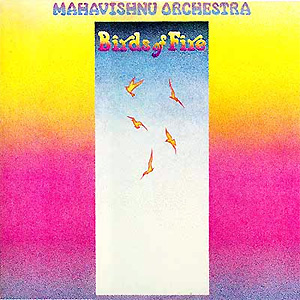
After recording benchmark electric jazz-rock fusion with Miles Davis, John McLaughlin formed Mahavishnu Orchestra to bring his interests in jazz, funk, and Indian music to new heights. Birds of Fire is the second LP issued by the original lineup, and it best showcases the concepts the group was exploring. Furious energy, solos seamlessly divided between band members, and a melding of international influences in original compositions are the order of the day. Listen to “One Word” for the band’s ultimate statement, a 5-way musical argument of colliding meters and self-aggrandizing phrases. With this kind of energy, it’s no wonder the band broke up so soon. If Mahavishnu Orchestra was a bright star, then Birds of Fire was its supernova. A thing so brilliant simply couldn't last. If I had to pick, I'd take some of the later members of Mahavishnu over the players in this lineup, for instance, Stanley Clarke over Rick Laird (I know! Saying so is blasphemy). But it's a damned hard band to beat on any level, and one of the greatest lineups ever assembled for any type of music. It's no wonder that Birds of Fire became a crossover hit with rock audiences.

Wednesday, April 4, 2012

The majesty of Duke Ellington

Duke Ellington was one of jazz's most prolific figures. In a career spanning over 50 years, his inimitable character and skills as bandleader, composer and arranger lifted the public perception of jazz from dance hall music to the level of a serious art form. Duke's output as a composer was unparalleled and today he is credited with over 1,000 compositions including film scores, operas, and hundreds of dance numbers that showcase soulful, bluesy melodies in lushly appointed arrangements.


His "three minute masterpieces" (one side of a 78 rpm record) were enthusiastically received by musicians and audiences alike. Many became standards and it is hard to pick up a jazz album that does not carry a credit to Duke Ellington. You don't have to be a jazz lover to be down with Duke Ellington, either. The music has a classic vibe with universal appeal, and music lovers of every stripe will enjoy the high quality performances of the Duke Ellington band. The best part: in recent years, much of Duke's work has been reissued on CD, digitally remastered with additional bonus tracks, outtakes and archival material so even if you're familiar with his work, you can still explore old favorites and find something new. Here are a few of my favorites, albums that I play regularly around my house and on the stereo at work.

Ellington Uptown (1952)
Originally released in 1952, the longer playing LP format allows Ellington to showcase several classics in full-length concert arrangements. Individual contributions from soloists are given center stage, notably the idiosyncratic bebop scat vocal of Betty Roche on "Take the 'A' Train," and Louie Bellson's definitive take of "Skin Deep." The rest of the set swings hard with help from trumpeter Clark Terry, tenor Paul Gonsalves, and others. Recorded during an impasse in Duke's career (due to the loss of Johnny Hodges), Ellington Uptown finds Duke stretching out and reinterpreting his back catalog for new listeners. What did he have to lose? Even without listening, you can expect the results to crackle with renewed energy and intensity that is sure to put goose bumps on your skin and set your feet to dancing.

Ellington at Newport (1956)
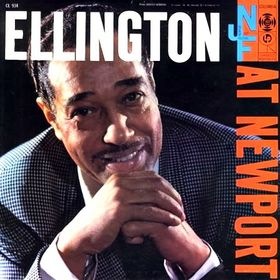
 In 1956, Duke Ellington headlined the Newport Jazz Festival. A recording of the concert was released as an album, and is widely appreciated as one of the finest of all time. Newport proved to be an event that revived Duke's career. During "Diminuendo and Crescendo in Blue," a striking woman in black evening dress stood up and began dancing wildly. The normally sedate crowd followed suit and after an epic 27 choruses by tenor Paul Gonsalves, the possibility of a riot nearly stopped the show. Ignoring offstage commands to leave the stand, Duke gave the crowd what it needed: a double shot of Johnny Hodges, followed by "Skin Deep" and a Sam Woodyard drum solo for the ages. After a tender performance of "Mood Indigo," Duke bid the crowd farewell: "You are very beautiful, very lovely and we do love you madly." Also not to be missed is the complete program preceding the madness, especially chestnuts like "Black and Tan Fantasy" and "Tea for Two."

Black, Brown, and Beige (1958)
 The album Black, Brown, and Beige takes its name from a jazz symphony that was Ellington's longest and most ambitious composition. It was originally written for his first performance at Carnegie Hall in 1943, although the music on this LP was not recorded until 1958. The composer described it as "a tone parallel to the history of the Negro in America." The complete work was performed live only twice, although selections of the piece were retained in the repertoire and performed on other dates and recorded piecemeal on other sides. For the 1958 studio session, gospel vocalist Mahalia Jackson, who Ellington referred to as the finest cook in North America, was called upon to sing the a capella "Come Sunday" -- a powerful spiritual, a bedrock to the work as a whole, and a fitting closer to the suite. The music is mature and evocative. Excellent arrangements and a strong sense of musicality will resonate with listeners of jazz and classical music.

Ellington Indigos (LP 1958, CD reissue 1987)
Listeners who associate jazz with squalling saxophones, hipster types and arcane music theory should take notice of Ellington Indigos. This oft overlooked little gem is notable for a few reasons. The selections are just like the title suggests: down-tempo jazz and pop standards, for the most part penned by other composers. I like to put it on while I making dinner in the kitchen. It's a thoroughly enjoyable listen from top to bottom, and a good introduction to the world of jazz which proves to the uninitiated that jazz is downright enjoyable and utterly timeless. Duke's provocative interpretations explore the emotive, bluesy potential hidden within each composition and allow listeners to hear old favorites anew. It may be just a pebble in an eddy of Duke's career, but Ellington Indigos is a suave, mellow delight that is sure to please not to be missed. The running order of the CD reissue is different from the LP, as is the cover, and "The Sky Fell Down" is omitted.

Saturday, February 25, 2012

Sun Ra / Blue Delight (1988)

If Mr. Ra is a mystery to you, then you have some detective work to do. For the uninitiated, Blue Delight is a good jumping off point. Sadly, like scads of other Ra recordings, it has fallen out of print. And that's a shame because this little powerhouse from 1988 could be as close as Sun Ra ever came to making jazz with mainstream appeal. Don't let that deter you -- it still crackles with the vigorous intensity and wild flair that put Ra and the Arkestra on the star map. Considering their more cacophonous and less accessible back catalog, this album is a particularly enjoyable spin. On standards like “Days of Wine and Roses” and “Gone with the Wind,” Ra showcases his skills as bandleader, arranger, and performer. In remarkably concise arrangements, he juxtaposes a noisy orchestra with serene, quiet interludes for startling dynamic contrast. Open sections allow soloists room to stretch out and interpret changes but Ra maintains a taut kineticism as if holding the Arkestra wound up in reserve and ready to spring. And spring they do, because the selections are not limited to classics. There are several spaced-out originals pushing 12 minutes in length, with gratuitous contributions from Arkestra stalwarts like Marshall Allen, John Gilmore, and Eloe Omoe. So if the total sound environment of atonal wailing by extended technique is your thing, you'll find plenty to dig your teeth into. The bottom line is that you're still listening to a Sun Ra record, albeit one that has been sweetened with a lifetime of experience. The musical goals are clearer and the combination of production quality and overall brevity make them more easily heard and understood.

Through the fracas of merging textures and clashing tonalities, Ra and the unusually large Arkestra (19 pieces!) still get wild, but never lose you by straying too far from recognizable scaffolds of harmony or melody. Don't get me wrong: I love the 70s Arkestras, too -- bands that worked so far inside the melody's harmonic architecture that it's more accurate to say the tunes were transmuted rather than interpreted. But here, thanks to the expert arrangements, you'll find the best of both worlds: the wild unknown realm of possibility, and the known universe of linear melody and conventional harmony. So new listeners will be safely introduced to the perilous realm of group improvisation while seasoned fans can still enjoy the frenzy of instrumental activity that is to be expected from Earth's resident Saturnian. Guest spots include Billy Higgins, Julian Priester, and Tommy Turrentine, who sound remarkably at ease with their surroundings and move through the music with facility and grace. Ra’s own playing serves as both anchor and centerpiece. In it can be heard the ghost of Erroll Garner’s left hand, and astute listeners will sense the impact of more angular, single-note excursions that recall Lenny Tristano. Steeped in the distant memory of blues and swing, Ra’s revered influences mingle with his unique proclivities and technical mastery to form an inimitable style that supports and enriches the high powered cast.

And please remember to turn up the volume for maximum effect.

Wednesday, February 15, 2012

A meditation on musical cornerstones and pillars

In masonry, a cornerstone is the first stone to be laid in the foundation of a building. This is an important stone because it determines the position of all other stones in the structure, as well as the structure's position on the site. Throughout history and into more recent times, special and sometimes esoteric significance has been applied to the laying of a cornerstone. I once thought that a similar concept applied to various styles of music and specific musicians, composers, or recordings within the style. But that comparison isn't perfect, in fact, it's completely illegitimate. Preplanned construction is fundamentally different than a community of musicians all working independently, and at their own whim. Only later does anyone say they created a particular style. I guess my purpose is more like describing archetypes but to avoid dabbling in Hegelian philosophy, I'll draw a new comparison. How about... pillars. For anyone living under a rock, pillars are vertical structures that support other elements through static resistance. A style is like a structure, and the major works upholding the style are like pillars. There. Happy?


In the coming weeks I'll examine some of my favorite musical styles, and discuss recordings that I think are the pillars of those styles. I'll also review some recordings that have special value for being influential to other artists making similar music. I'll start with the PILLARS OF PSYCHEDELIC ROCK (sounds cool, doesn't it?), an international subgenre of rock and roll that I find endlessly fascinating. Stay tuned, please, and don't drop out... well, not yet, anyway.

Saturday, February 4, 2012

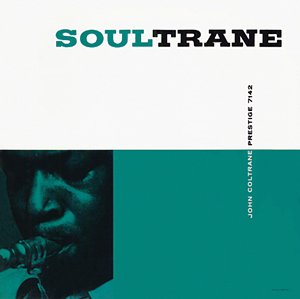
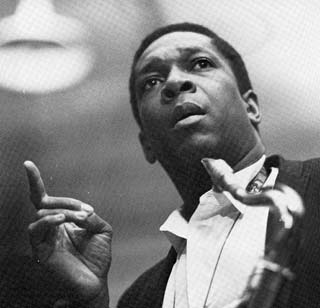
John Coltrane / Soultrane (1958)

Soultrane is just two sides long, a total of five cuts clocking in around 40 minutes, but it's pretty special. After first listening, critic Ira Gitler famously coined the term "sheets of sound" to describe Coltrane's wild new improvisational technique. That's a nice description, conjuring up cool imagery while defining in simple language what Coltrane was doing, which wasn't very simple at all. Or maybe it was devilishly simple? "Sheets of sound" refers to how Coltrane played hundreds of notes in a given solo at a lightning pace, creating dense aural textures that thrummed the ears like a raging waterfall. "His continuous flow of ideas without stopping really hit me," Gitler said. "It was almost superhuman. The amount of energy he was using could have powered a spaceship." That's wild language but it's hardly an overstatement. After you listen to Soultrane, compare what you hear to the other big tenors of 1958, and you'll immediately agree. It's a wonder the record doesn't fly right out the window.

I won't go into reviewing specific tracks, although the whole first side really shines, especially the opener, which is Tadd Dameron's "Good Bait." Instead, I'd like to say a few words about why I think the album is one that you need in your collection and why it stands as something of a watershed recording in jazz music.

John Coltrane was always an expressive soloist. Maybe it was his early days playing with the big-bellied alto of Earl Bostic that taught him to blow heavy soul through the horn. And his tenure under Miles Davis and Thelonious Monk certainly allowed Coltrane to explore the experimental side of his technique. But by 1958 he had found the formula to liberate his ideas from the bonds of harmonic theory based on chord progressions. It was an exciting time in jazz, and many young musicians were embracing modal techniques. Instead of waiting for a chord change to arrive and then playing a new selection of notes (much like a runner jumping hurdles), Coltrane piled the chord changes on top of one another within the moment the chord was played. This 'vertical' interpretation of harmony kicked open the door to a whole galaxy of tonal colors, making virtually anything possible - and correct - within the solo. Along with a sympathetic rhythm section, Coltrane now inflected his music with a special, new emotive quality and furious intensity. When I listen to Coltrane burn through a chorus, I close my eyes and see someone running madly through the halls of an art museum, arms outstretched, tagging the paintings on either wall before shooting out the door and collapsing on the steps.

One of my responsibilities as a librarian in the media department is to advise music listeners. After an advisory interview concerning jazz, I'll recommend Coltrane if it's relevant to what the patron is looking for. And interestingly, I've found that of the entire Coltrane canon, Soultrane has the distinction of being the album that most people who don't like Coltrane can actually enjoy. I've met more than a few jazz listeners who make a frightened face when I mention Trane or any of his records. Oh, how they love Zoot Sims and Hank Mobley! Nice boys. But somehow, the press succeeded in making people believe that you're either crazy or must enjoy differential calculus to enjoy John Coltrane. Nothing could be farther from the truth. After dishing Soultrane to skeptics, the same people often return and ask for more. Look at the credits and it's easier to understand what I mean: there are no Coltrane originals here, no weird intervals and arcane music theory. Instead you'll find standards from top to bottom, venerable tunes by the likes of Billy Eckstine, Tadd Dameron, Irving Berlin, played by the most competent quartet in the business. But you've never heard them like this.

The lineup is one of the most famous bands in jazz history. Coltrane, of course, leads on tenor with Red Garland on piano, Paul Chambers on bass, and Art Taylor on drums. Garland had a remarkable intuition for ensemble playing, and could build the mood like a tidal wave. The whole group was really quite telepathic in that sense, a seamlessly cohesive collaboration of creative genius and natural talent. By listening to the whole group interact, you feel Garland's effect which acts as a musical glue that binds the sound. Garland built on his band members' momentum and his initiative behind the piano controlled the rhythmic swell like he was working a throttle. Pay attention: after Coltrane finishes a chorus, you'll sense the band bumping into a higher gear. This is the difference between a good band and one that is merely competent. While soloing, Coltrane really gets out on a limb, pouring out successions of scales in breath length phrases. Garland is right there behind him, ever listening, interplaying with his own lines on the piano, so when Coltrane finishes, the band surges ahead with renewed urgency. But Garland is also a gifted soloist alternating between rich, soulful block chording and arpeggiated explosions of twinkling notes that shower listeners with an inexhaustible pallet of color. Paul Chambers is no slouch either, always fractions ahead of the beat, a guy who liked to cook. His deep tones are an audible heartbeat, the pulse of the group, and he moves like a phantom through the modal inclinations of his band members, adding to the mood and providing the backbone.

It's an important album for a jazz listener to appreciate, but it's also just good fun to listen to and that's the important part. It's a record where everything seems to come together and make sense, and every time I listen feels like a special occasion. Take my word for it, try dropping the needle on Soultrane during your next Thanksgiving dinner.

Wednesday, February 1, 2012

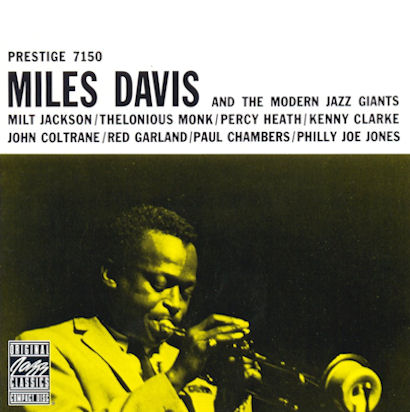
Miles Davis and the Modern Jazz Giants (1958)

Miles Davis and the Modern Jazz Giants is one of my favorite jazz albums. I'm a big fan of most Prestige releases but this one is especially enjoyable. It is positively brimming with musical excitement and high quality performances make it an easy candidate for repeat listening. The tracks are culled from a session recorded Christmas Eve, 1954 by the inimitable Rudy Van Gelder. It's an impressive roster by any measure: Milt Jackson on vibes, Percy Heath on bass, Thelonious Monk on piano, Kenny Clarke on drums and of course Miles playing the horn. "Round Midnight" is odd man out, recorded in 1956 by the same lineup heard on Steamin'. If you're at all familiar with the various groups led by Davis in the 1950s, then this misfit should stick out like a sore lip. The feel is completely different, and the personalities don't bounce off each other the same way. It's an awesome take, and any take with Coltrane is a bonus in my book, but it's obviously a different band and it just doesn't sound anything like the rest of the album.

The sheer chemistry is what jumps out at me most. There is tangible musical evidence of the friction caused by Monk working under Davis' direction. Monk didn't like being told to lay out during Miles' solos, and so when he takes one of his own, he really lets you know he's there. The result is a pleasing musical tension that spins topsy-turvy somewhere between mood and mechanics.  There are few pianists who understand rhythm and dissonance like Monk, and his penchant for playing the perfectly wrong note in the perfectly right spot is maximized here. Phrases of Monk's sparse, single note solos hang across the bars, as if to be completed at a later date, creating time within time. Through such economy, the impact of his absence is even stronger and the tunes acquire a presence that is felt as much as heard. The album isn't all Monk, I just mention him because his work is notable. Really, if there's one standout star then it's Milt Jackson on the vibes. Jackson provides the fabric for the whole album, smoothing it over like sand filling in fault lines, providing both body and character. At times, his licks seem to intervene between Monk and Davis, and tie the arrangements together like string. Meanwhile, Clarke and Heath are a rock, their interplay with soloists and solid timekeeping during heads propelling the music in interesting new directions. Not to be forgotten, Miles' tone on the horn is characteristically creamy and his solos are filled with chilled out, mid-register phrases that smolder in their simplicity. By not flying up the scales or playing successive double-time runs, Davis maintains a consistent atmosphere that focuses his ideas and swells the music with controlled intensity. Hours after listening, the strains ring in my ears and I have to put it on again. It's almost addictive. Almost. If Kind of Blue was missing and I had to choose one album to serve as a new listener's introduction to jazz, this very well might be it. So do yourself a favor, hunt down a copy. The CD reissue by Original Jazz Classics is an excellent alternative to the original LP.

Curious? Want some more? Have a gander at MilesDavis.com
Impress your friends and purchase a Harmon trumpet mute.

Thursday, January 26, 2012

The Pogues / If I Should Fall from Grace with God (1988)

Aaah, the Pogues. They took Irish folk music, stripped it down to the nerve, and then strapped what was left to the back of a freewheeling, green-eyed punk machine. The result was a radioactive new music that blasted through speaker cones like Godzilla in a donnybrook. Out of all the Pogues' original albums and EPs, it's damned hard for me to choose a favorite. I even like Waiting for Herb, just so you know who you're talking to. But it's this Pogues slab that gets the most play around my house, and quite possibly because it's the only one that survived.

If I Should Fall from Grace with God was produced by Steve Lillywhite in 1988. His approach retained the attitude and drive of the band, while showcasing their skills as instrumentalists and songwriters. MacGowan's lyrics, his poetry, are a joy to read even without music, and here they finally see the light of day at the front of the mix. There's plenty of barking and howling, too, but between the primal punctuation marks, a listener can actually make out what he's singing. If you've ever burned time trying to discern Michael Stipe's autistic mumble in an REM song only to come up with more riddles than you started with, you'll appreciate the relative no-brainer presented by Grace. MacGowan has a gift for turning a phrase within the kinetic context of a rock and roll song that few other songwriters can manage. The product is something that works both melodically and as a narrative. Sketches of story fly by, vague impressions are tossed out, and any guesswork is left to the imagination, guided by the mood of the music behind the words.

Lillywhite's slick production is evident from the outset (these tracks sound organized!), but you know you're getting a Pogues record when you hear the aftermath of the title track's cascading accordion intro, MacGowan's cracked snarl, and classic shoutalong chorus describing a victorious day at the races. Instead of a bridge, many songs employ a thundering interlude where the band breaks into another tune. "Turkish Song of the Damned" has a Middle Eastern feel but is backed by the banshee wails of fellow band members, and sudden modulations in key follow each determined section. There's even holiday appeal in the twisted Christmas carol "A Fairytale of New York" where MacGowan trades barbs with Kirsty MacColl in call-and-response format. The cynical quips and rich imagery are pure Poguetry.

There's almost too much good music to get into here. If you buy the CD, you'll get two extra tracks that were omitted from the LP and cassette releases due to time limitations. Looking at prices around the net, I'd say it's a stonking bargain.

If you've read enough of this review and want to buy the record, try hitting up a seller at Discogs.com.
If you'd like to learn about the Pogues from a more credible source, then visit the Pogues official website.

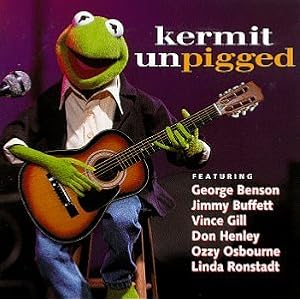
The Muppets & Various Artists / Kermit Unpigged (1994)

In the 90s, it seems that practically everybody was invited to MTV Unplugged, even Aerosmith. So why not the Muppets? I'd have rather watched the Muppets than Aerosmith, but to my knowledge they were never extended an offer. So in 1994, the people at Jim Henson Records took matters into their own hands and released this little gem. Part exploitation, part rollicking fun, Kermit Unpigged is an album that's equally good for children or adults, who are basically grown up children anyway.

Each track is a duet done by one or more Muppets and the various artists they meet while wandering the halls of a recording studio. I love the selections. Vince Gill playing the Lovin Spoonful's "Daydream" or Jimmy Buffett singing the Byrds' "Hey Mr. Spaceman" are lost nuggets that are not to be missed. Conversations between Gonzo and Buffett in "Hey Mr. Spaceman" seem to put to rest the notion that Gonzo is not of this Earth, although he does indicate, repeatedly, that he has had contact with spacecraft or extraterrestrials many times in the past.  I guess that's not really surprising.

Later on, Miss Piggy, while searching for Kermit (who is having a rendezvous with Linda Ronstadt), walks in on Ozzy Osbourne who asks her to sit in on "Born to be Wild." After the rocking arrangement draws to a close, Ozzy passes out and Miss Piggy continues her search. Don Henley makes an appearance, singing "Bein' Green" with Kermit. The result is a touching little ballad that wouldn't be out of place next to "Desperado." George Benson also shows up, and sings "Up On Broadway" with Clifford and the Rhythm Rats, gratifying listeners midway with a short but bluesy guitar solo. The banter and storyline between tracks is as good as the music, and the album has the feel of watching a skit from the Muppet Show. Things wrap up by everyone singing "All Together Now" with Harry Smith. When I first saw the track listing, this made me do a wild double take. But no, it's not the brilliant Harry Everett Smith. It's the plain old Harry Smith of CBS news. Different guy.

Sadly, Jim Henson Records chose BMG as the distributor, who failed to promote the album. Despite favorable reviews from critics, it ended up a commercial failure and is now out of print. Seriously, what were the executives at JHR thinking, hadn't they ever been ripped off by BMG before? 

To learn more about the "real" Harry Smith, click here for Harry Everett Smith Archives.
To learn more about the guy from CBS news, click here for his page in the Muppet Wiki.

Saturday, January 21, 2012

10,000 Maniacs / MTV Unplugged (1993)

I first heard 10,000 Maniacs when I was young and a new kid named Dane moved in down the block. His parents were younger than mine and instead of having record collections laden with albums by the Beatles and Stones, they had a closet filled with cassette tapes of newer, different music that I had never heard. One afternoon we walked in the house and his mom was listening to the recently recorded 10,000 Maniacs MTV Unplugged. The song was "Hey Jack Kerouac" and I was hooked. Dane made fun of me for complementing his mom's wimpy acoustic music, although neither of us had any idea who Jack Kerouac was.

The Maniacs' studio output is superb, but the Unplugged set does a fine job of capturing the group's grown-up essence on disc. Some of what they do here, mostly the cuts from Our Time in Eden, are not a whole lot different than their studio counterparts. But other arrangements are a major departure from the jangly, danceable college rock we're all familiar with. I think it's a change which works well, and one which reflects the mature polish of band's final studio album. A dark mood pervades the disc that is better suited to expressing the songs' lyrical content. The occasion has a heavy atmosphere, inspiring a bittersweet feeling somewhere between a graduation and a funeral. That inertia could stem from Merchant's impending departure, marking an end to the band and the era. Either way, the theme of farewell is underscored by a solemn but joyful delivery, as well as the audience's gratuitous appreciation between tracks which seems to say thank you and goodbye all at once.

The group is supported by a modest orchestra of vocalists, strings, and winds, plus the mandolin, pipe organ, and slide guitar. This diverse ensemble is arranged with a nod to sparse utility, never overpowering Merchant's vocals or overpowering the songs themselves. Sophisticated contours of the Maniacs' trademark folk-pop hybrid are brought to the fore and the best qualities of the songwriting - interplay between melody and lyrics, vocalist and instrumentation - are laid before listeners with stark new contrasts of impact and subtlety. Each song has different instrumentation so listening to the whole album is very engaging and never monotonous. Songs like "Hey Jack Kerouac" and "Because the Night" are rendered with fresh enthusiasm and a rich new aural textures. "Eat for Two" is finally given a musical treatment that is appropriate for its lyrics. The performances are patient and relaxed, allowing the music plenty of space to bloom. For a recording of a taped television appearance, the audio quality is surprisingly good, too. 

For writing on other Maniacal topics, I recommend Don Ignacio's 10,000 Maniacs page.
To purchase this album on the format of your choice, try hitting up a seller at Discogs.com