Duke Ellington was one of jazz's most prolific figures. In a career spanning over 50 years, his inimitable character and skills as bandleader, composer and arranger lifted the public perception of jazz from dance hall music to the level of a serious art form. Duke's output as a composer was unparalleled and today he is credited with over 1,000 compositions including film scores, operas, and hundreds of dance numbers that showcase soulful, bluesy melodies in lushly appointed arrangements.

His "three minute masterpieces" (one side of a 78 rpm record) were enthusiastically received by musicians and audiences alike. Many became standards and it is hard to pick up a jazz album that does not carry a credit to Duke Ellington. You don't have to be a jazz lover to be down with Duke Ellington, either. The music has a classic vibe with universal appeal, and music lovers of every stripe will enjoy the high quality performances of the Duke Ellington band. The best part: in recent years, much of Duke's work has been reissued on CD, digitally remastered with additional bonus tracks, outtakes and archival material so even if you're familiar with his work, you can still explore old favorites and find something new. Here are a few of my favorites, albums that I play regularly around my house and on the stereo at work.
 Ellington Uptown
 (1952)
Originally released in 1952, the longer playing LP format allows Ellington to showcase several classics in full-length concert arrangements. Individual contributions from soloists are given center stage, notably the idiosyncratic bebop scat vocal of Betty Roche on "Take the 'A' Train," and Louie Bellson's definitive take of "Skin Deep." The rest of the set swings hard with help from trumpeter Clark Terry, tenor Paul Gonsalves, and others. Recorded during an impasse in Duke's career (due to the loss of Johnny Hodges), Ellington Uptown finds Duke stretching out and reinterpreting his back catalog for new listeners. What did he have to lose? Even without listening, you can expect the results to crackle with renewed energy and intensity that is sure to put goose bumps on your skin and set your feet to dancing.
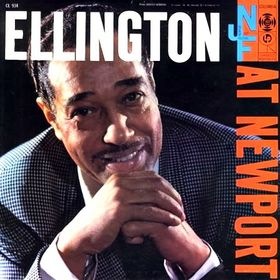 Ellington at Newport
 (1956)
In 1956, Duke Ellington headlined the Newport Jazz Festival. A recording of the concert was released as an album, and is widely appreciated as one of the finest of all time. Newport proved to be an event that revived Duke's career. During "Diminuendo and Crescendo in Blue," a striking woman in black evening dress stood up and began dancing wildly. The normally sedate crowd followed suit and after an epic 27 choruses by tenor Paul Gonsalves, the possibility of a riot nearly stopped the show. Ignoring offstage commands to leave the stand, Duke gave the crowd what it needed: a double shot of Johnny Hodges, followed by "Skin Deep" and a Sam Woodyard drum solo for the ages. After a tender performance of "Mood Indigo," Duke bid the crowd farewell: "You are very beautiful, very lovely and we do love you madly." Also not to be missed is the complete program preceding the madness, especially chestnuts like "Black and Tan Fantasy" and "Tea for Two."
 Black, Brown, and Beige
 (1958)
The album Black, Brown, and Beige takes its name from a jazz symphony that was Ellington's longest and most ambitious composition. It was originally written for his first performance at Carnegie Hall in 1943, although the music on this LP was not recorded until 1958. The composer described it as "a tone parallel to the history of the Negro in America." The complete work was performed live only twice, although selections of the piece were retained in the repertoire and performed on other dates and recorded piecemeal on other sides. For the 1958 studio session, gospel vocalist Mahalia Jackson, who Ellington referred to as the finest cook in North America, was called upon to sing the a capella "Come Sunday" -- a powerful spiritual, a bedrock to the work as a whole, and a fitting closer to the suite. The music is mature and evocative. Excellent arrangements and a strong sense of musicality will resonate with listeners of jazz and classical music.
Ellington Indigos (LP 1958, CD reissue 1987)
Listeners who associate jazz with squalling saxophones, hipster types and arcane music theory should take notice of
Ellington Indigos. This oft overlooked little gem is notable for a few reasons. The selections are just like the title suggests: down-tempo jazz and pop standards, for the most part penned by other composers. I like to put it on while I making dinner in the kitchen. It's a thoroughly enjoyable listen from top to bottom, and a good introduction to the world of jazz which proves to the uninitiated that jazz is downright enjoyable and utterly timeless. Duke's provocative interpretations explore the emotive, bluesy potential hidden within each composition and allow listeners to hear old favorites anew. It may be just a pebble in an eddy of Duke's career, but
Ellington Indigos is a suave, mellow delight that is sure to please not to be missed. The running order of the CD reissue is different from the LP, as is the cover, and "The Sky Fell Down" is omitted.


